optimise
cleaning in place

A leading North American dairy company contacted us following a major problem encountered during a clean-in-place (CIP) cycle.

Despite procedures being in place, persistent anomalies were putting pressure on production continuity and confidence in the cleaning process. We therefore conducted this use case to understand, objectify, and secure the situation.
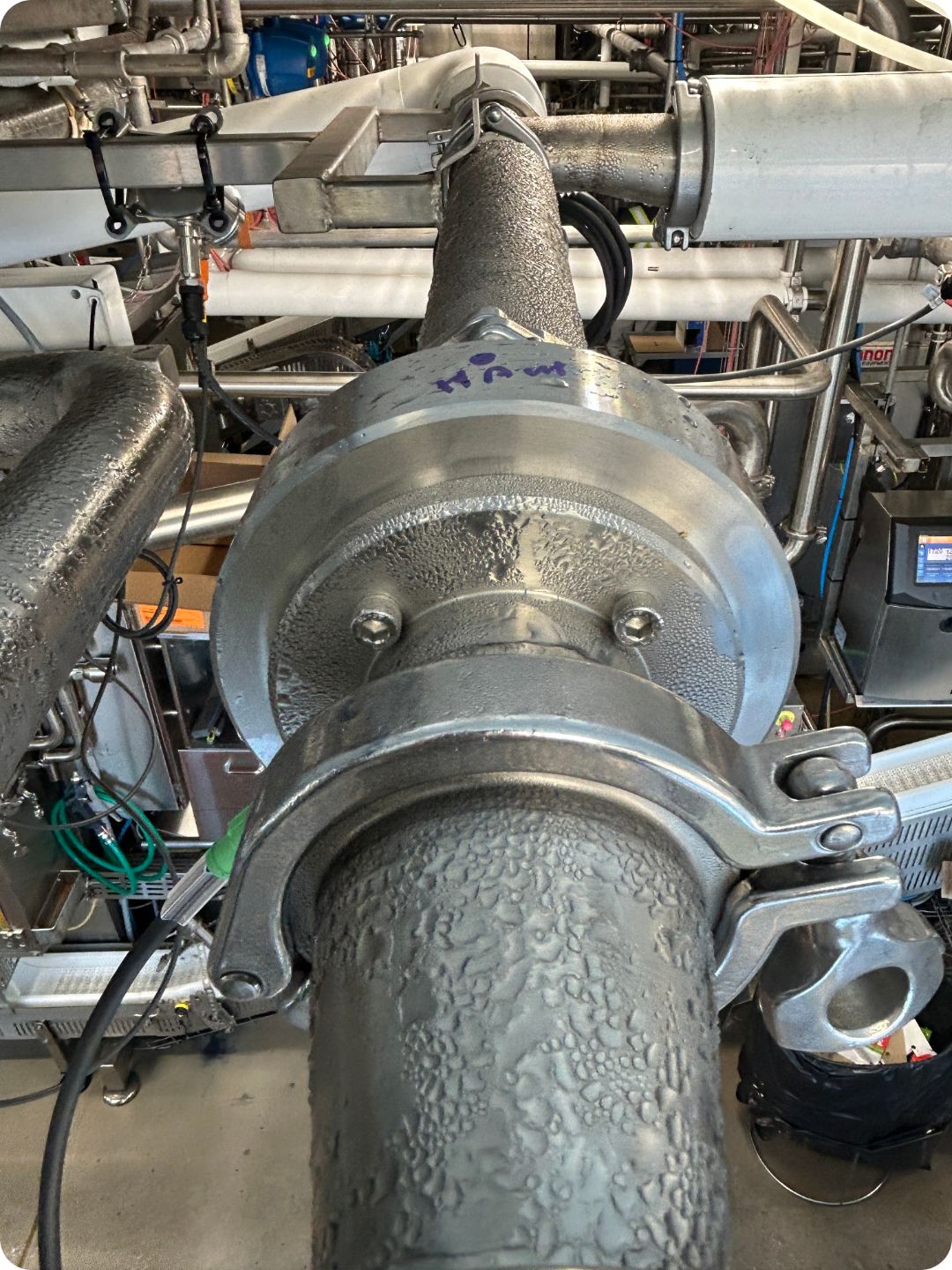
Cleaning in place (CIP) in dairies: reducing milk and water losses

the limitations of sensors in the face of process constraints

fragility of the equipment

Measuring equipment is subject to extreme conditions. The sudden transition from steam heated to 120°C to milk stored at around 4°C generates violent and repeated thermal shocks.

The result: most standard sensors become fragile. They suffer from measurement drift or outright hardware failure, forcing the operator to navigate blindly or replace equipment frequently.

Process uncertainty

When water is added to pure milk, the product becomes a mixture, making it difficult to determine with certainty the exact moment when the product becomes pure again.

The consequence: Due to a lack of precision, the machines are set with excessive safety margins (time delays). This inevitably leads to large volumes of milk/water mixture being discharged into the drain. Litres of usable raw material are thus lost with each cycle.

Operational inefficiency

Uncertainty about the reliability of sensors and the actual cleaning status forces teams to be cautious.

The result: Lack of visibility leads to corrective (rather than predictive) maintenance and time-consuming manual checks. Every minute spent doubting a measurement or replacing a faulty sensor is a minute of lost production.


The Fluiidd solution: Transforming NEP constraints into performance levers

Conductivity analysis for total flow control
Unique Signature

Each fluid (milk, water, soda, acid) has a unique conductive fingerprint. Our scanner reads this fingerprint continuously, like a barcode, ensuring flawless identification of your production phases.

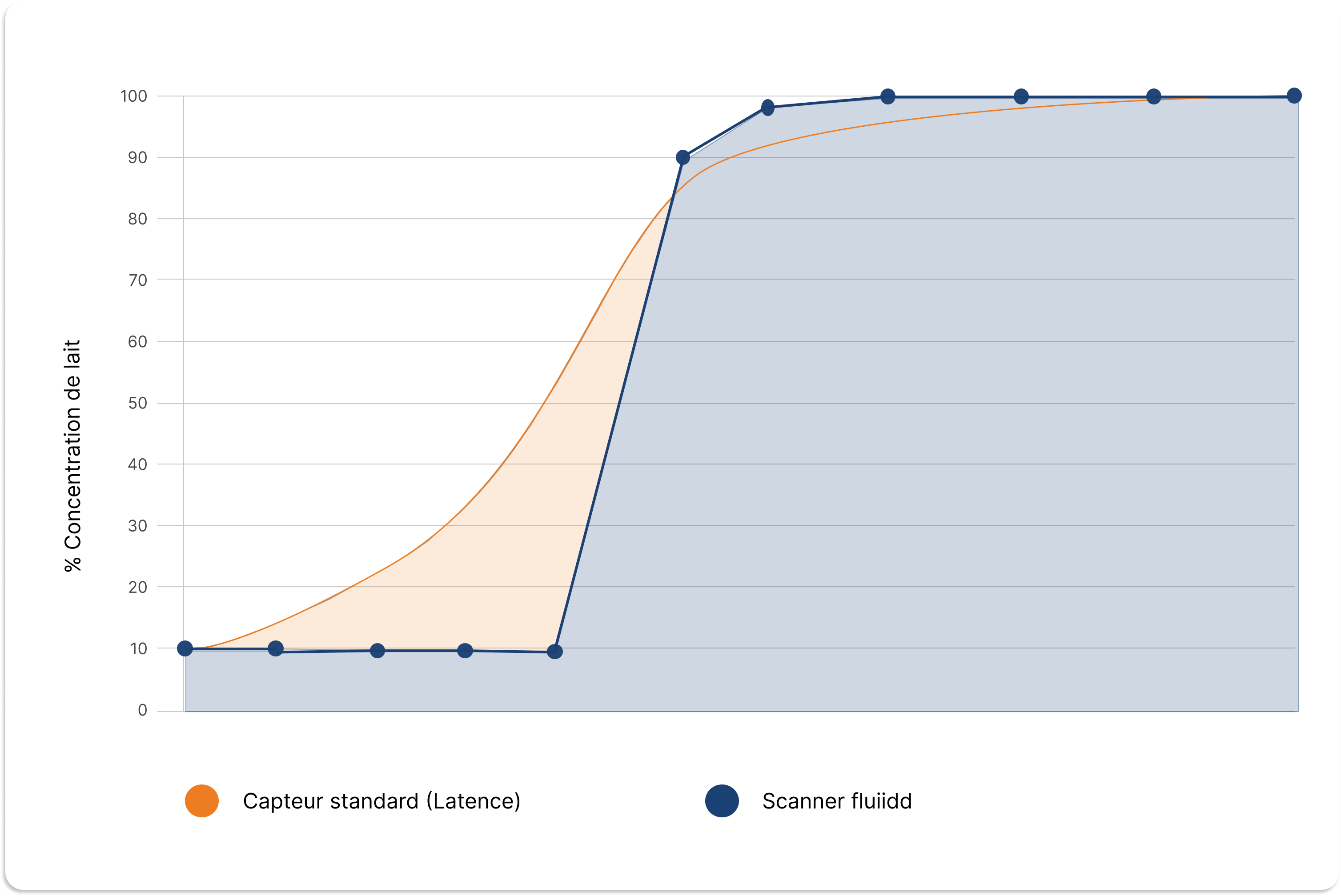
But the real technological breakthrough lies in the absence of latency. Unlike standard sensors, which react and ‘smooth’ the analysis curve, the fluiidd scanner reacts in real time. This speed of acquisition eliminates material inertia.

Removal of the grey area: The orange area on the graph represents the standard safety margins (mixture of product/water sent to the sewer). fluiidd eliminates this uncertainty.

Precision cutting: Interface detection is so fast that it allows for surgical control of your bypass valves.

Safety and efficiency: You no longer dilute your pure product in the tank, and you no longer discard raw materials as a precaution.

Blindness is costly

Without precise visibility, you apply time safety margins. The result: thousands of liters of water/milk mixture sent to the sewer or to methanisation.

The clean break

fluiidd identifies the exact interface. You close the valve at the moment when the milk is pure. 0% dilution in the tank, 0% milk in the drain.

Non-intrusive & Robust

Series installation
Custom diameter
No moving parts, low maintenance
We use cookies
Cookie preferences
Below you may find information about the purposes for which we and our partners use cookies and process data. You can exercise your preferences for processing, and/or see details on our partners' websites.
Analytical cookies Disable all
Functional cookies
Other cookies
Nous utilisons des cookies pour personnaliser le contenu et les annonces, pour fournir des fonctionnalités de réseaux sociaux et pour analyser notre trafic. Learn more about our cookie policy.
Accept all Decline all Change preferences
Cookies