

How a Leading North American Dairy Company Stopped Sending Its Milk Down the Drain
During each CIP cycle, liters of recoverable raw material were discarded as a safety precaution. Here’s how we minimized those losses without affecting production.
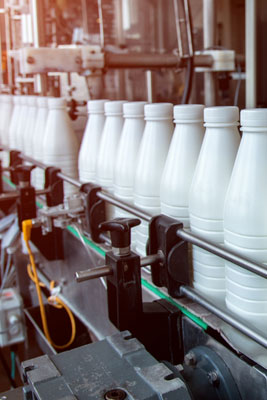
In a nutshell
Client:
A North American leader in the dairy industry
Sector:
Dairy processing, food production lines
The challenge:
Reduce milk losses during CIP cycles, where usable raw material was previously flushed down the drain as a precaution during each transition
The solution:
The SCAN42 scanner, installed in-line, which measures the fluid's signature in real time and detects the exact interface between milk and water
The result:
Zero dilution of milk in the tank, zero pure milk sent to the sewer, and a switch between reject and production modes down to the second
Invisible waste, in every dairy
Every time there is a product changeover and at the end of each cleaning cycle, perfectly usable milk is flushed down the drain. This invisible waste occurs cycle after cycle in every dairy.
liters of milk lost each year in France during processing
in annual financial losses for the industry
0.7 to 2 M
liters of milk wasted every day in France
The Challenge
The client: a leading dairy company determined to recover the raw material lost in each cycle
A major player in the North American dairy industry, our client decided to tackle this waste without compromising cleaning safety or interrupting production. They reached out to us to understand what was actually happening inside their pipes.
There is no certainty as to when the milk becomes pure again
During the water flush, the milk becomes a mixture, and there is no way to tell exactly when the product is pure again. The machines are therefore set with excessive safety margins, and liters of usable raw material are flushed down the drain with each cycle.
Sensors that drift due to thermal shocks
During each cycle, the equipment is subjected to rapid temperature fluctuations, ranging from 120 °C to 4 °C. These repeated temperature shocks cause standard sensors to deteriorate, leading to measurement errors, malfunctions, and frequent replacements. As a result, the operator ends up operating blindly.
Teams forced to exercise caution
Without visibility into the actual status of the cleaning process, teams are forced to perform more and more manual checks. The result: continuous maintenance instead of predictive maintenance, and time-consuming checks that reduce site productivity.
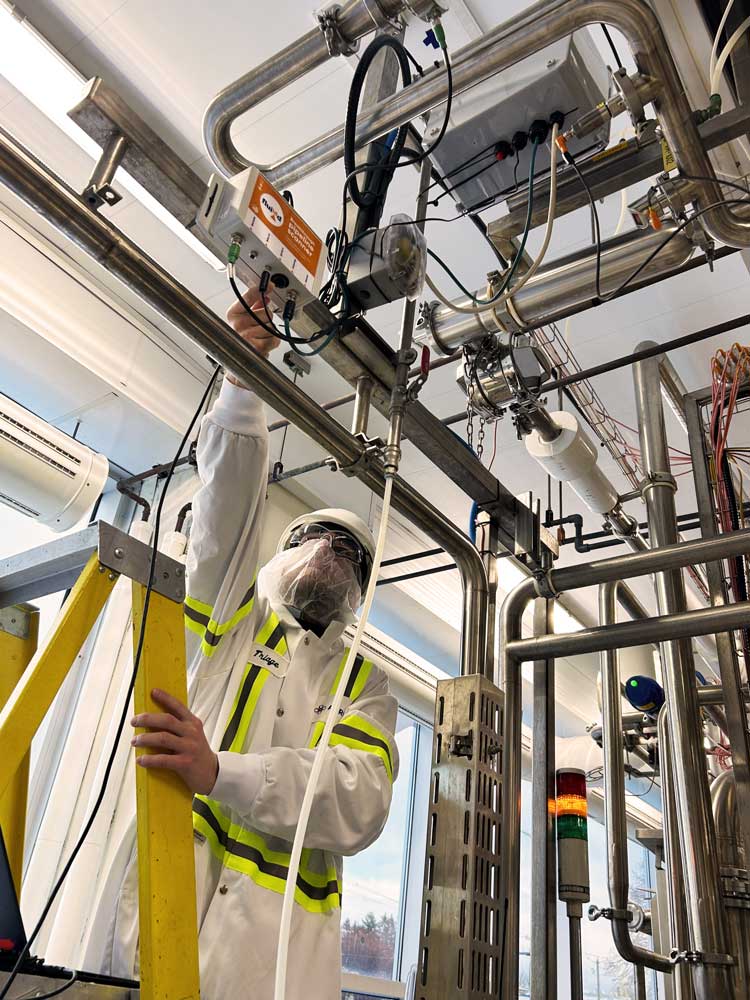
The solution: the clean cut
From blindness to surgical precision
Every fluid has a unique fingerprint. The SCAN42 continuously reads this fingerprint, much like a barcode, and instantly identifies the exact stage of production.
Before - Fixed delay
We wait as a safety measure, with a time delay set for the worst-case scenario
A gray area: the milk-and-water mixture goes down the drain
Some of the pure milk already in the pipeline is being rejected
Dilution of the product in the tank; diluted milk to be reprocessed
After - SCAN42
The actual fluid signature is measured continuously
The valve is shut off at time T, when the milk is pure
The exact interface is identified, and the area of uncertainty disappears
Zero dilution, optimized cycle, fewer detergents
Why does it work?
1
Real-time, latency-free measurement: conductivity + temperature + embedded AI to identify the fluid's signature down to the second.
2
Easy and robust installation: in-line installation with no moving parts, low-maintenance, compatible with the most intensive CIP cycles (aggressive detergents, pressures up to 40 bar, significant temperature differentials).
3
Health and safety: Designed to prevent buildup and contamination. Certified to CE, FCC, and CSA standards, as well as food contact and drinking water standards.
4
The result of more than 10 years of R&D at the CEA on nuclear reactor safety, this technology is designed for environments where measurement errors are not permitted.
The result
Results at the client's site
%
milk dilution in the tank
%
of fresh milk poured down the drain
In a second
switch from reject to production
On the client's line, the uncertainty has been eliminated. The valve is no longer triggered by a timer but by a measurement. Raw milk remains in the production line, the CIP cycle is shortened, and the amount of detergents and diluted milk requiring reprocessing is reduced.
Take this brochure home: optimize your CIP cycles
Details on the dairy case, how SCAN42 works during product transitions, and key industry figures, all in a document to share with your teams.
Frequently Asked Questions
display-none
Is the SCAN42 compatible with food safety standards?
Yes. The scanner is designed to prevent any buildup or contamination, and it is CE, FCC, and CSA certified, meeting food contact and drinking water standards. It is designed for the most demanding food production environments.
Does the installation interrupt production?
During installation (30 min), the line must be taken out of production. The scanner is installed in series on the pipeline; it has no moving parts and does not disrupt the flow. The diameter can be custom-adjusted if necessary. Maintenance is minimal.
Can the sensor withstand the harsh conditions of CIP?
Yes. It's optimized for the most demanding CIP cycles: aggressive detergents, pressures up to 40 bar, and severe thermal shocks between hot steam and chilled milk. The very conditions that cause standard sensors to drift or fail.
How can I tell if it works on my own line?
This is the turnkey pilot program: we install the SCAN42 on one of your production lines, collect real-world data for one to three months, and then provide you with an analysis and an ROI estimate for your production cycles. You can assess the potential savings before making any decisions.
What technology is the measurement based on?
The scanner measures the fluid's electrical conductivity and temperature in real time, and then an onboard AI identifies its signature to detect the exact interface between two products. The technology is the result of more than ten years of R&D at the CEA on nuclear reactor safety.
See the SCAN42 in action
And on your production line, how much milk goes down the drain every day?
Whatever we've measured for this client, we can measure for you. On your own production line, under real-world conditions, with comprehensive support from installation through to the results.
Have you ever measured what your CIP cycles actually discharge into the sewer?
ROI Qualification Workshop with Your Teams
2 hours, free of charge, to estimate your current losses and the potential savings on your CIP cycles.
Turnkey pilot project on a production line
We install the SCAN42, collect the data, and provide you with an analysis and an ROI estimate based on your actual cycles. Results are available in 1 to 3 months.