

Two-phase void fraction measurement at 330 bar, with Framatome and the CEA
Quantifying the void fraction in the hot leg of a pressurized water reactor, under extreme conditions and with no moving parts, to validate accident simulation codes.
A partnership between Framatome, the CEA and fluiidd.
In a nutshell
Client:
Framatome × CEA - an industrial and research partnership in the French nuclear sector
Sector:
Nuclear energy - Reactor safety
Experimental thermal-hydraulic research
The challenge:
Experimentally validate the calculation codes for a loss-of-coolant accident (LOCA) by quantifying the two-phase void fraction in the hot leg of a Pressurized Water Reactor (PWR) primary circuit
The solution:
Adapt and evaluate the fluiidd scanner on a test loop under extreme conditions, to validate the sensor's robustness and measurement accuracy
The result:
Sensor validated under extreme conditions
Void fraction quantified from 0% to 100%, in steps of 10%
Quantifying the two-phase void fraction under high pressure:
a critical challenge for energy production
In nuclear safety, a detailed understanding of thermal-hydraulic behavior, particularly in accident scenarios, is a top-priority regulatory and scientific requirement. The loss-of-coolant accident (LOCA) is the most studied scenario in the industry. But modeling is not enough: a simulation code is only valuable when compared against real measurements, under near-process conditions. Hence the obstacle: how can you measure a void fraction, and thus track the progression of the accident, in a circuit at extreme pressure and temperature?
This is the subject of the partnership between Framatome, designer of French nuclear reactors, the CEA, a nuclear research organization, and fluiidd.
nuclear reactors in operation in France
major nuclear accidents worldwide
155 bars
the primary circuit pressure of a PWR
The Challenge
3 constraints that rule out standard instrumentation
Operating conditions that rule out standard instrumentation
The test loop operates at pressures reaching 330 bar and high temperatures. No commercially available sensor was able to withstand these stresses while maintaining void fraction measurement accuracy.
The absolute requirement for measurement with no moving parts
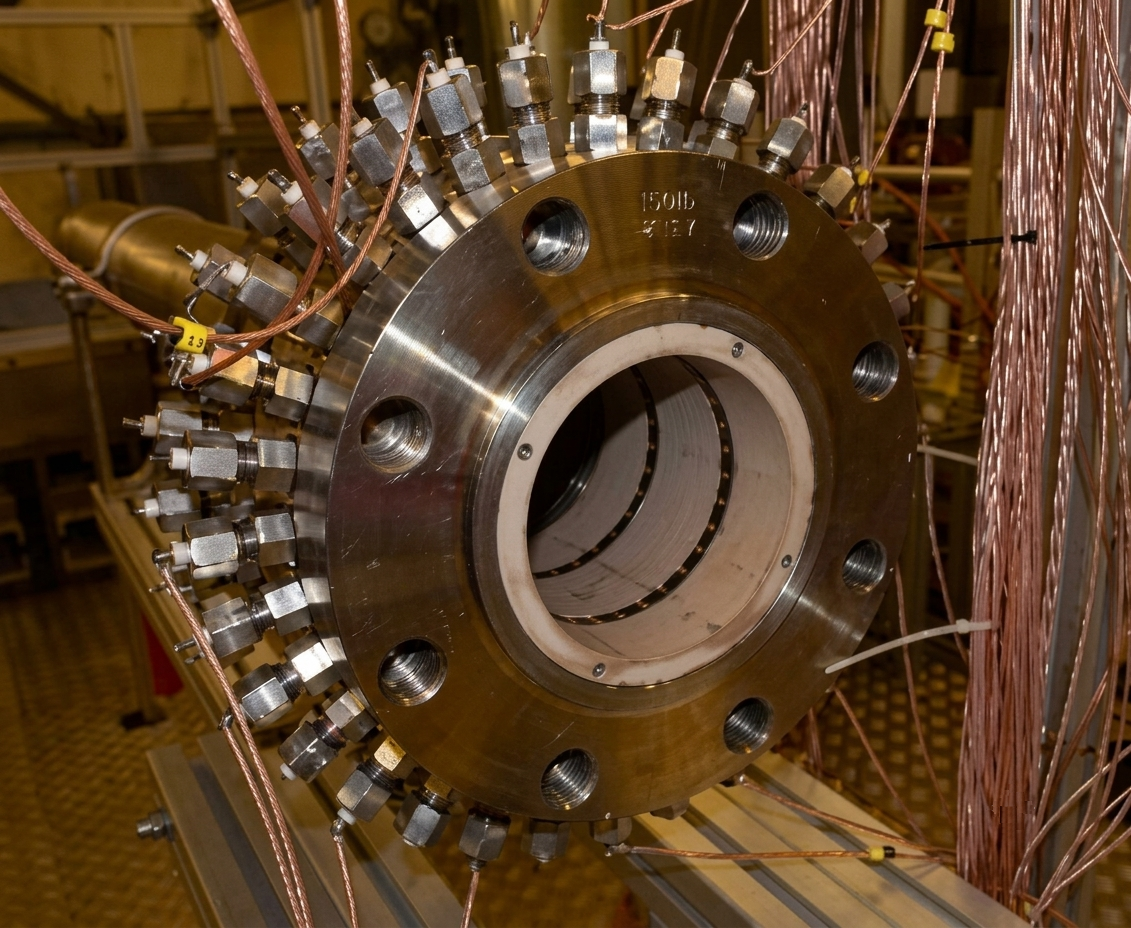
In a primary circuit, each mechanical component is a point of risk. The specifications required instrumentation that could be integrated into a custom spool piece, with no moving parts, designed to withstand repeated pressure and temperature stresses.
Qualify robustness before using any data
Before even considering data exploitation, the absolute priority was to demonstrate that the sensor survived the loop conditions. Mechanical qualification was an essential prerequisite.
The Solution
Deployment method:
from defining the phenomena to mechanical validation
The deployment was carried out on the Benson loop with a view to later installation on PKL, a facility that reproduces at 1:1 height scale the geometry and thermal-hydraulic conditions of a four-loop 1,300 MW nuclear power plant.
- Characterize: analyze the thermal-hydraulic behavior during depressurization of the hot leg: two-phase flow, water/steam interfaces, thermal transients.
- Qualify: design, in collaboration, a robust spool piece to install the fluiidd scanner under representative pressure and temperature conditions.
- Secure: validate through testing the sensor's resistance to mechanical and thermal stress cycles.
Before - Conventional method
Simulation codes not experimentally validated on the hot leg
Standard instrumentation unusable at 330 bar and high temperature
Any intrusion into the primary circuit introduces additional risk.
Risk of mechanical failure under extreme conditions
After - SCAN42
Measurement data directly comparable with calculation codes
Sensor with no moving parts, designed to withstand severe loads
Dedicated spool piece and installation with no process modification
Robust technology from 10 years of R&D, validated in real-world conditions
The result
What this validation means for your industrial processes
1
Measure where conventional sensors fail: high pressure, high temperature, two-phase flows, with no moving parts and no risk of mechanical failure.
2
Experimental validation of your models: real data to test your simulations and strengthen your technical and regulatory documentation.
3
Custom integration through co-engineering: spool piece and flange adapted to your configuration, developed with your mechanical teams as Framatome did
4
Robustness proven under extreme conditions: validated on the Benson loop at 330 bar, with resistance to rapid thermal transients.
5
Reproducibility cycle after cycle: stable, usable measurements across all test sequences, with no drift or recalibration between cycles.

Download the fluiidd scanner datasheet
A practical way to assess compatibility with your processes.
Frequently Asked Questions
display-none
Is the fluiidd scanner compliant with the regulatory requirements of critical industrial environments?
Yes. The fluiidd scanner is CE and FCC certified. For each deployment, we validate the fit between the specific requirements of the client and their industry and the SCAN42 scanner.
Does the installation affect production?
No. The fluiidd scanner is installed directly inline on the pipe, with a flange adapted to your configuration. For non-standard configurations, a custom spool piece can be co-engineered with your mechanical teams.
How can I validate the fluiidd scanner on my own line before any commitment?
fluiidd offers a turnkey pilot lasting 1 to 3 months, with supported installation, data monitoring and a performance review at the end. This is the most suitable format to validate the technology in the specific context of your process and operational objectives.
What measurement technology is the fluiidd scanner based on?
The fluiidd scanner relies on electrical impedance tomography (EIT). By measuring the distribution of electrical conductivity across the pipe cross-section, it reconstructs the gas/liquid phase distribution and derives the void fraction, in real time and with no moving parts or radioactive source.
See the SCAN42 in action
Measurement zones inaccessible on your process? Let's talk about it.
Interface detection, two-phase flows, pressurized circuits: what Framatome and the CEA validated under nuclear conditions, you can deploy at your site.
Fill out this form and we will get back to you to discuss your challenge.
Installation in just a few hours
Compatible with your existing equipment
CE and FCC certified
Developed from CEA research