

How a naval defense player can finally see inside its ships' water circuits
On board, the condition of water circuits is checked through spot measurements and by opening up circuits. Here is how SCAN42 brings continuous monitoring to support MRO, for better control over the ship's operation.
fluiidd, winner of the French Navy's 2024 AI Predictive Maintenance Innovation Challenge
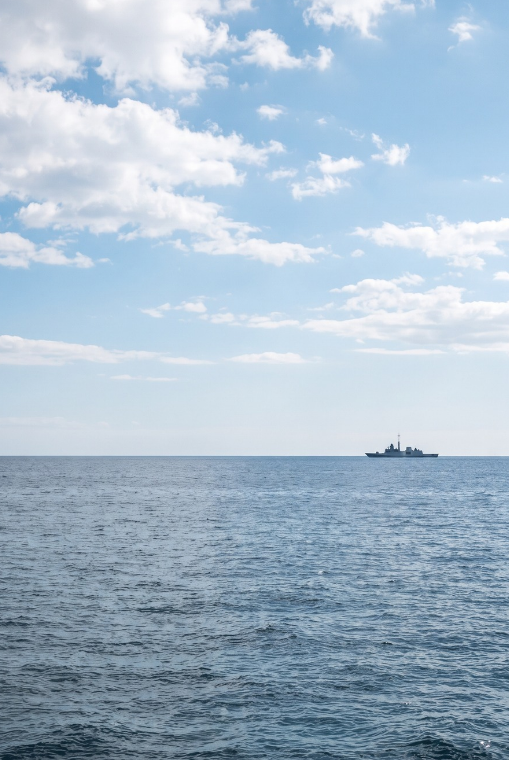
In a nutshell
Client:
A European leader in naval defense
End user:
A European navy
Sector:
Naval defense, maintenance in operational condition (MRO) of ships
The challenge:
Knowing the actual condition of water circuits on board between two inspections, without opening healthy circuits to inspect them
The solution:
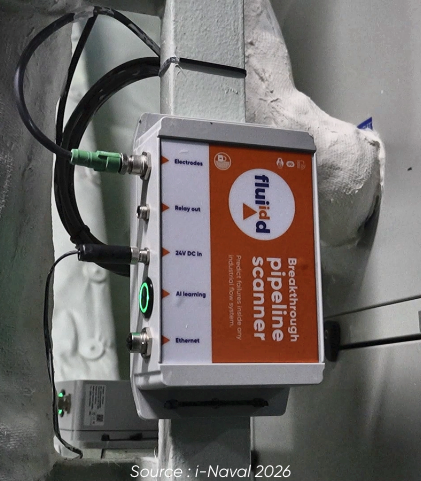
SCAN42 installed inline on one of the ship's water circuits. It observes the inside of the pipe in real time, and its embedded AI interprets the measurement on board.
The result:
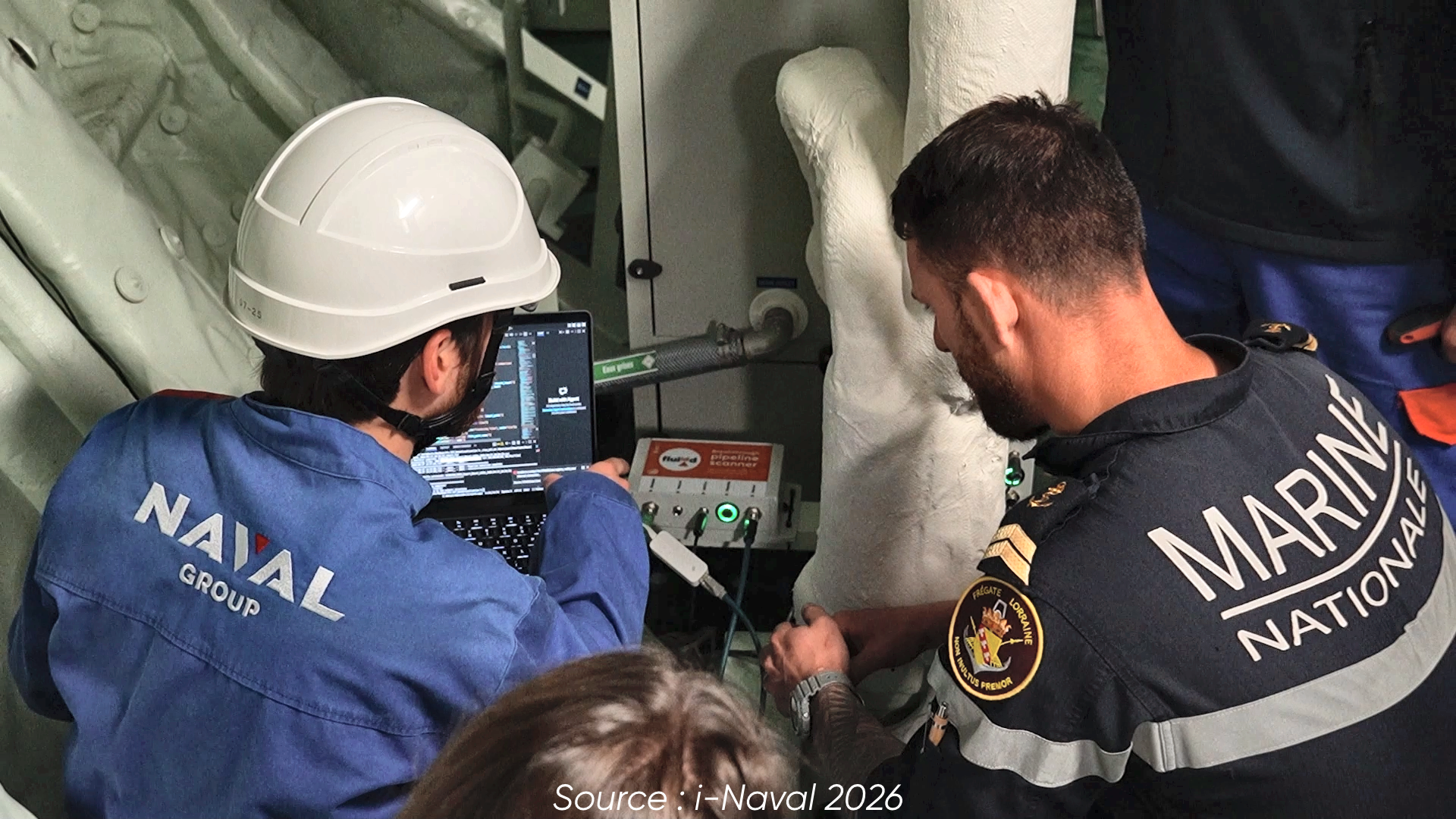
8 months of measurements, 2 sea campaigns, 4 scanners installed on a surface ship. Automatic detection and classification of the events seen in the pipework.
Machinery damage, the leading risk in the maritime sector
Damage develops long before it shows. Progressive fouling, clogging, biofilm: these slow drifts escape spot checks.
Across the global fleet, machinery damage remains the leading cause of incidents. Fleets are aging, and the oldest vessels account for most incidents. These figures relate to the merchant fleet, but civilian vessels and naval ships share the same limitation: between two inspections, no one can see what is happening inside their water circuits.
Source: Allianz Commercial, Safety and Shipping Review 2026, June 2026 (vessels over 100 GT).
%
of maritime incidents reported in 2025 were caused by machinery damage or failure
average age of the global fleet in 2025
%
of safety incidents involve vessels over 20 years old
The Challenge
Seeing inside water circuits
As major players in European naval defense, our clients want to reduce unavailability caused by the maintenance of water circuits on board. They asked us to track the actual condition of these circuits during the operation of a surface ship.
No visibility between two inspections
On board, water circuits are monitored through spot measurements. Between two inspections, nothing shows what is happening inside the pipework. Weak signals and slow changes go unnoticed.
Healthy circuits opened up for inspection
Without visibility, maintenance follows a fixed schedule. The crew opens circuits that did not need it. Every unnecessary opening costs hours of unavailability, and every missed drift can end in a breakdown.
No data leaves the ship
On a defense vessel, communications with the outside world are prohibited. No cloud, no remote link. The measurement is interpreted inside SCAN42, and the information goes straight to the maintenance teams on board.
The Solution
From spot inspection to continuous monitoring
Every fluid has a signature. SCAN42 continuously reads the fluid's signature in the pipe, and its embedded AI interprets it on board, in real time.
Before - Fixed-interval maintenance
Spot measurements, nothing between two inspections
Healthy circuits opened for inspection
Slow drifts discovered late
Damage discovered in service
After - SCAN42
The circuit's actual condition, continuously visible
Interventions decided based on measured condition
Slow drifts spotted from the first weak signals
Alerts can be sent to the maintenance manager on board
Why does it work?
1
A real-time image of the inside of the circuit: electrical impedance tomography, 4 flush-mounted electrodes, imaging rate of 31,250 Hz.
2
100% on-board processing: the AI interprets the measurement inside the scanner. No data stream leaves SCAN42, with no reliance on the cloud. Teams receive conclusions, not raw images.
3
Integration with on-board systems: easy inline installation of the scanner unit, remote electronics box connected by cable, no moving parts.
4
A technology born in the nuclear sector: over 10 years of R&D at the CEA in reactor safety, 5 patents.
fluiidd won the French Navy's AI Predictive Maintenance Innovation Challenge (2024), with the award presented by the head of the Fleet Support Service. SCAN42 was also among the innovations showcased at i-Naval 2026, in the Innovate sequence. Watch the presentation video
The result
What this first deployment demonstrates on board
of measurements
measurement campaigns at sea
scanners installed on a surface ship
During these trials, SCAN42 automatically detected and classified the events seen in the pipework, with 100% on-board processing of the measurement and no external link. Slow drifts become visible before they can turn into breakdowns. Maintenance can be decided based on the measured condition of the circuit, not just the calendar.
Download the SCAN42 brochure
SCAN42 in detail: how it works, its technology and its applications, in a document to share with your teams.
Frequently Asked Questions
display-none
Can SCAN42 be installed on an existing circuit?
Yes. It is installed inline on the pipe, like a flowmeter, with no moving parts. The measuring section is built into a sleeve, while the electronics box is remote and connected by cable. The diameter and flange are adapted to your configuration.
Does installation require a shutdown?
The circuit concerned must be isolated during installation, which can be scheduled during a planned maintenance period. Once in place, SCAN42 does not disturb the flow.
Does any data leave the ship?
No. All interpretation takes place inside the scanner, with no cloud. SCAN42 delivers its conclusions as standard industrial signals, according to your needs.
What anomalies does the SCAN42 detect?
It continuously tracks how the pipe contents evolve. It can detect progressive fouling, water hammer, cavitation and other types of flow problems. The simplest way is to contact us: together, we will assess whether your need is feasible.
How can I test SCAN42 on my own circuits?
With a pilot line. We deploy SCAN42 on one of your ship's circuits, the AI is calibrated to your actual conditions, then we provide you with an analysis and an ROI estimate. Results in 1 to 3 months.
What technology is the measurement based on?
On electrical impedance tomography (EIT). SCAN42 measures the conductivity distribution across the pipe cross-section, reconstructs an image and interprets it using embedded AI. The technology comes from more than ten years of R&D at the CEA. If you want to learn more, you can download our Technical Note explaining our technology.
See the SCAN42 in action
And on your ships, what happens between two inspections?
What we measure on board this ship, we can measure on your circuits
Under real conditions, with support from installation through to results.
Talk with an expert
A discussion with our technical team to assess your circuits and your MRO challenges.
Pilot line on one circuit
We install SCAN42, calibrate the AI to your actual conditions and provide you with an analysis and an ROI estimate. Results in 1 to 3 months.
Meet us at Euronaval, November 3-6, 2026, Paris Nord Villepinte, SEAnnovation area, Hall 6, booth K104-2.